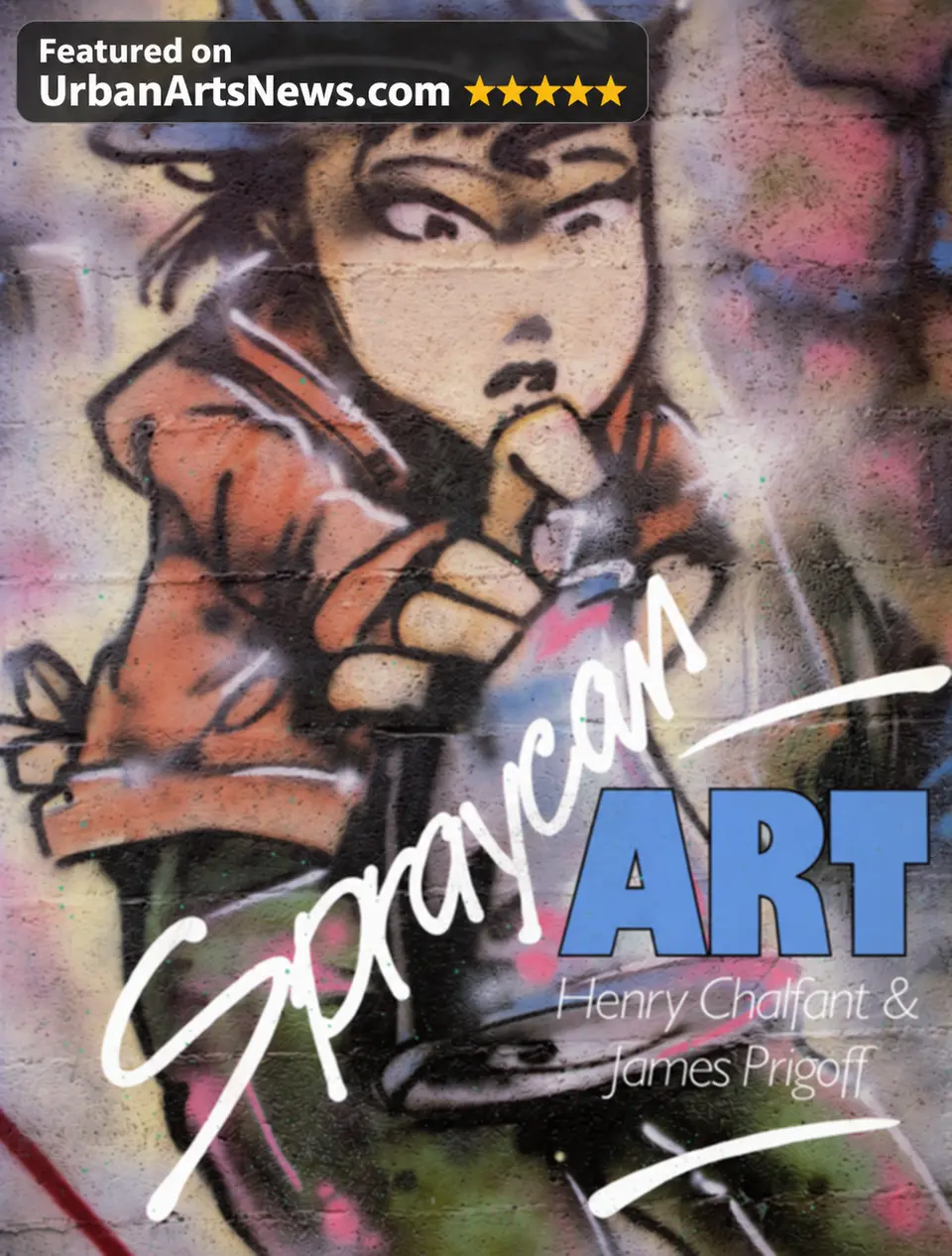
Some books document a culture after it has settled into history. Spraycan Art did something more urgent: it appeared while graffiti was still expanding, mutating and travelling across borders. Published by Thames & Hudson in 1987, Henry Chalfant and James Prigoff’s book captured the moment when a visual language associated with New York’s subway system had moved onto walls and entered cities across the United States, Europe and beyond.
After Subway Art, a wider world
Three years earlier, Martha Cooper and Henry Chalfant’s Subway Art had given readers an unprecedented view of New York train writing. Its photographs became a portable school of letter construction, colour, characters and whole-car composition. Spraycan Art widened the lens. Chalfant and Prigoff looked beyond the subway and showed how writers were adapting the culture to walls, legal sites and local urban conditions.
This distinction is central to the book’s historical importance. It did not present graffiti as a style that remained fixed in its birthplace. It showed a movement in translation. The New York foundations were visible, but so were new accents, new surfaces and regional solutions. Readers could compare the discipline of classic lettering with large wall productions whose scale allowed writers to develop backgrounds, figures and complex colour relationships.
Henry Chalfant and the art of preservation
Henry Chalfant’s place in graffiti history is inseparable from his ability to photograph work that was difficult to see and easy to lose. His subway images reconstructed passing trains as complete visual objects, allowing writers and readers to study paintings that might otherwise survive only as memory. His involvement with Style Wars and his work on Subway Art made him one of the decisive documentarians of hip-hop’s visual culture.
In Spraycan Art, that documentary knowledge meets James Prigoff’s sustained interest in murals and public art. Prigoff had travelled extensively to photograph community murals and became fascinated by the way graffiti moved above ground and outward from New York. Together, the authors approached walls not as isolated curiosities, but as evidence of a connected cultural phenomenon.
The wall becomes a new stage
A train imposed movement, metal seams, windows, doors and a short lifespan. A wall created different opportunities. Writers could work at greater scale, build deeper scenes and collaborate on productions that combined letters, characters and backgrounds. The book’s emphasis on wall painting revealed graffiti’s ability to occupy architecture and transform neglected or ordinary surfaces into public visual events.
The pages feature established New York writers as well as artists from emerging scenes elsewhere. The result is not a simple catalogue of names. It is a study of how techniques travel. Arrows, outlines, shines, three-dimensional effects and character styles appear in different combinations, copied and then altered by writers working far from the original subway lines.
Europe sees itself in the story
For European graffiti writers, Spraycan Art carried a special force because Europe was not treated merely as an audience for American culture. The book showed that cities such as London, Paris, Vienna and Barcelona were already participating in the movement. Writers including Bando, Mode 2 and members of The Chrome Angelz demonstrated that European work could absorb New York’s lessons while developing its own ambition and visual identity.
That recognition mattered. Before social media, online archives and instant global communication, a book could function as a network. A single copy might circulate through an entire crew, school or city. Pages were studied repeatedly, images were traced, colour schemes were analysed and unfamiliar names became reference points. In many places, access to books and films determined which fragments of graffiti history a young writer could see.
A generation learned from printed pages
Spraycan Art became one of graffiti’s essential visual textbooks. It offered no formal lesson plan, yet writers learned from every spread: how letters could overlap without losing structure, how an outline could separate colour from a difficult background, how characters could support a name and how several artists could organise a wall as a unified production.
The learning was not based on passive admiration. Writers copied elements, tested them in sketchbooks, painted them, discarded what failed and gradually developed personal styles. This is how an image in a book could influence a wall thousands of kilometres away without producing an exact replica. The printed photograph became a starting point for local invention.
Together with Wild Style and Style Wars
The international rise of graffiti cannot be attributed to one object. It emerged through a constellation of films, books, music, travel and personal exchange. Yet a small group of cultural documents had exceptional reach. Wild Style gave graffiti a cinematic world connected to MCing, DJing and breaking. Style Wars showed the artists, conflicts, trains and political battle over public space. Subway Art offered close visual study of New York’s painted trains.
Spraycan Art completed another part of the picture: it demonstrated that the culture had escaped geographical containment. By 1987, graffiti was no longer only a New York story exported as fantasy. The book showed an international community taking shape in real time. For the new graffiti wave in Europe, that was both instruction and confirmation.
From imitation to distinct European styles
Early writers outside New York often began by imitating the images available to them. That was not a weakness; it was how the vocabulary was learned. The decisive step came when cities developed their own conditions and preferences. Paris, Amsterdam, London, Munich, Zurich, Vienna, Copenhagen and Barcelona did not remain visual copies of the Bronx. Their scenes produced different attitudes toward trains and walls, different lettering rhythms and different relationships with design, punk, club culture and local politics.
Spraycan Art captured that transition. Its worldwide perspective suggested that authenticity did not require geographic proximity to New York. What mattered was commitment to style, participation in a scene and the ability to add something of one’s own. This helped transform graffiti from an imported American phenomenon into a genuinely international culture with strong local chapters.
Why the book still matters
Today, millions of graffiti images can be found in seconds. Abundance, however, is not the same as context. Spraycan Art preserves a carefully framed historical moment when global graffiti networks were young and visual information remained scarce. Its sequence of images allows readers to see not only finished paintings, but also the relationship between cities, generations and approaches.
The book also reminds us that documentation shapes the history it records. Countless works disappeared without photographs, while the paintings selected for influential books became part of a shared canon. Chalfant and Prigoff did not merely record graffiti’s international expansion; their book actively accelerated it by placing these images into hands around the world.
A landmark of global urban art
Spraycan Art is one of the most important graffiti books ever published because it captured the movement at the point of worldwide transformation. It connected New York’s foundational style writing to an expanding map of cities and showed a generation that graffiti could be both globally connected and locally specific.
Alongside Wild Style, Style Wars and Subway Art, the book helped form the visual education of countless writers. Its influence lives in old sketchbooks, remembered colour combinations, letter experiments and walls painted decades after its first publication. More than a collection of photographs, it is a record of the moment spray-can culture recognised itself as a world movement.
Spraycan Art by Henry Chalfant and James Prigoff
Explore the landmark 1987 graffiti book and check current availability.
View the book on Amazon →Advertising disclosure: As an Amazon Associate, Urban Arts News may earn from qualifying purchases. This does not increase the price you pay.
Sources and further information: Thames & Hudson · Urban Nation Martha Cooper Library