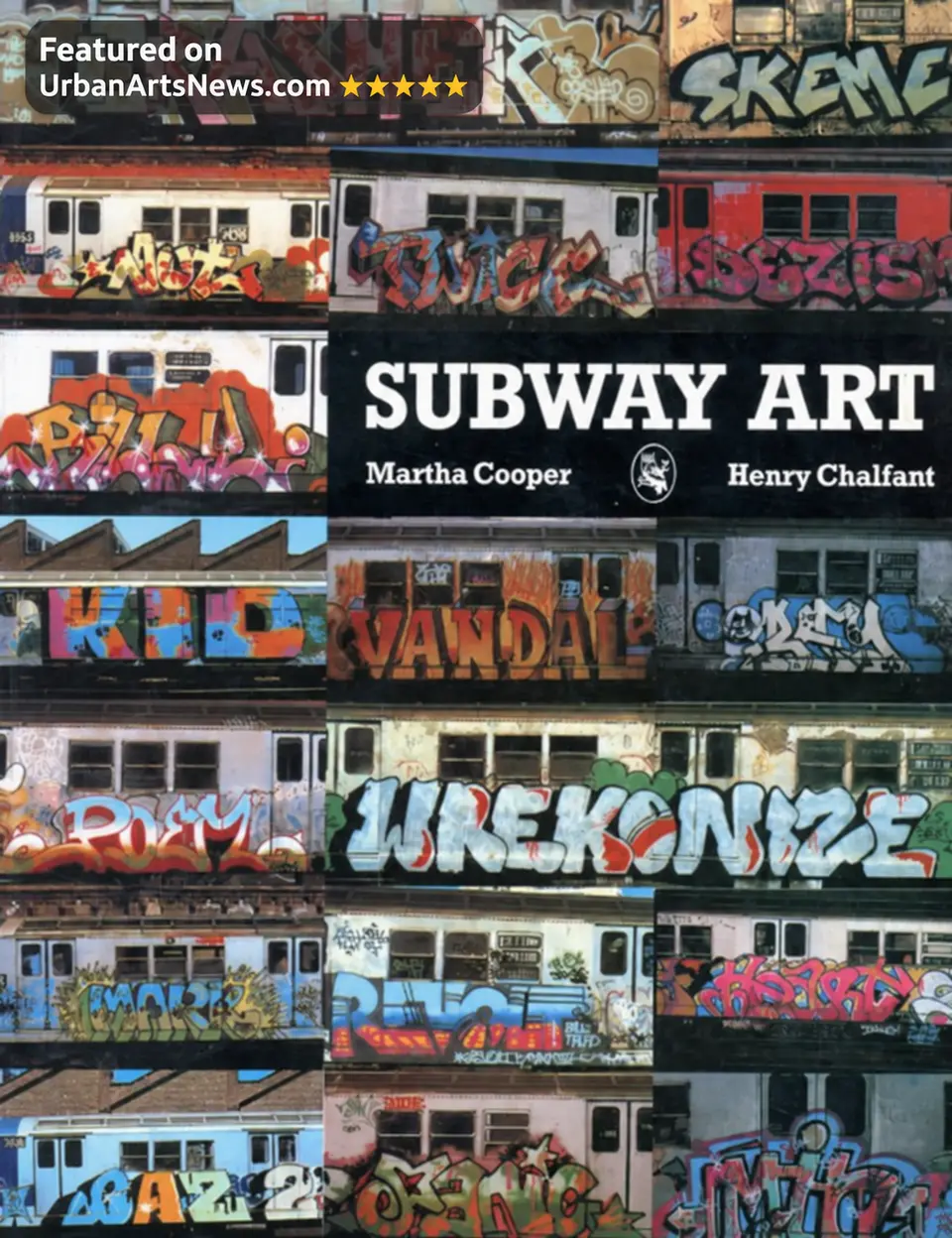
Few books have changed the visual culture of cities as profoundly as Subway Art. First published in 1984, Martha Cooper and Henry Chalfant’s photographic record of New York City subway graffiti placed an underground and deliberately temporary art form into a book that could cross borders, survive repainting and be studied repeatedly. Writers around the world came to know it simply as the graffiti bible.
A moving gallery photographed before it disappeared
During the 1970s and early 1980s, New York’s subway cars carried an astonishing range of names, characters and letter forms. A painted train could travel through several boroughs, reach thousands of viewers and vanish beneath fresh paint soon afterward. Cooper and Chalfant understood that photography was not secondary to this culture. It was often the only lasting record of a work created under extreme time pressure and designed to move.
Chalfant developed a way of photographing passing trains in sections and assembling the images into complete side views. Cooper documented writers, neighbourhoods and the wider social world surrounding the paintings. Together their photographs preserved both the finished pieces and the human culture that produced them.
Style could now travel without the train
The physical subway system kept the trains inside New York, but the book released their images into the world. A writer in London, Paris, Amsterdam, Munich, Zurich or Barcelona could examine a whole car for as long as necessary: the outline, fill, highlights, background, characters and the way letters were adapted around doors and windows.
This access was revolutionary in an era before online archives. Copies were passed between friends, studied in libraries, traced into sketchbooks and sometimes taken apart through constant use. For young writers outside the United States, the book became a visual curriculum. It did not merely show that graffiti existed—it demonstrated the depth of its style system.
Why the letters mattered
To an outsider, subway graffiti could appear chaotic. The book revealed structure inside that apparent chaos. Writers competed through originality, scale, placement and technical control. Simple tags led to throw-ups; throw-ups developed into increasingly complex pieces; whole cars became coordinated compositions. Names such as DONDI, SEEN, LEE, BLADE, ZEPHYR and LADY PINK became reference points far beyond New York.
The photographs allowed viewers to compare approaches. Some pieces relied on clarity and force; others pushed wildstyle complexity until letters became almost architectural. Characters, clouds, arrows, shines and three-dimensional extensions were not decorative additions alone. They helped establish identity and movement.
Subway Art and Europe’s first graffiti wave
In Europe, the book arrived at precisely the moment when young people were searching for information about hip-hop and New York writing. The culture was transmitted through fragments: record sleeves, imported magazines, television reports, films, travellers and rare photographs. Subway Art concentrated an entire visual universe between two covers.
Its impact differed from city to city, but the pattern was widely recognisable. One copy could influence a crew; one crew could influence a neighbourhood; a few active cities could establish a national scene. Early European writers learned New York’s vocabulary through imitation and then transformed it according to local trains, walls, languages and design traditions.
For Switzerland, Germany, France, the Netherlands, Scandinavia, Italy, Spain and the United Kingdom, the book was not simply foreign documentation. It became working material. Pages were analysed like diagrams. Letter forms were copied, corrected and eventually pushed in new directions. Europe’s strongest scenes soon developed their own identities, but Subway Art remained part of their shared foundation.
Together with Style Wars and Wild Style
The book’s global influence cannot be separated from the two films that defined how many international audiences first understood hip-hop culture. Wild Style presented a fictional story populated by real artists, musicians and locations. Style Wars documented writers, families, officials and the political struggle over New York’s subway system. Both gave movement and voice to the world visible in Cooper and Chalfant’s photographs.
Yet a book offered something film could not. It could remain open on a desk. A single image could be studied for hours. It could enter a classroom, bedroom, youth centre or train journey without equipment. The combination was extraordinarily powerful: films delivered atmosphere and attitude, while Subway Art provided the detailed visual evidence.
Photography, authorship and memory
The success of the book also changed how graffiti photography was understood. The photographers were not neutral observers collecting curiosities. Their choices—where to wait, when to press the shutter, which image to publish and how to sequence it—helped construct the historical record. Because painted trains were cleaned and scrapped, photographs became the archive through which later generations encountered the work.
That archive remains invaluable, but it also reminds readers how much was lost. Many pieces were never photographed; many writers were never published. Subway Art is therefore both expansive and necessarily selective. Its power comes from the quality of what it preserves, not from a claim to contain every part of the culture.
Why Subway Art still matters
Today, graffiti images circulate instantly. Writers can follow work from another continent in real time. Yet Subway Art remains essential because it shows a culture before that constant visibility existed. The work had to be found in the city, caught on film and physically reproduced. Scarcity gave each photograph unusual weight.
The book is also a reminder that graffiti was a sophisticated visual language long before institutions widely accepted it as art. Its pages show discipline, invention, rivalry and collaboration on a scale that transformed the everyday infrastructure of New York.
A book that created generations
Calling Subway Art influential is almost too modest. Together with Wild Style and Style Wars, it helped create the conditions for a worldwide movement. It gave young people access to images that would otherwise have remained local and temporary. It taught them that a name could become an image, that letters could carry identity and that the city itself could become a medium.
Across Europe and beyond, countless writers can trace part of their visual education to this book. Some copied its styles directly; others reacted against them; many returned years later with a deeper understanding of what Cooper and Chalfant had preserved. The trains belonged to New York, but the book made their visual legacy global.
Subway Art by Martha Cooper and Henry Chalfant
Explore one of the foundational books of modern graffiti and check current availability.
View the book on Amazon →Advertising disclosure: As an Amazon Associate, Urban Arts News may earn from qualifying purchases. This does not increase the price you pay.
Editorial context: This article discusses the book’s documented role in graffiti history and its international cultural influence. Product availability and seller information are controlled by Amazon and may change.